Bison Paintings and the Spirit of the American West
Sep 11, 2026
The American bison is more than a recognizable animal of the Great Plains. It has become one of the defining symbols of the American West, closely connected to open grasslands, Western history, Native cultures, and the changing landscape of North America.
That history gives a bison painting a different character from a typical wildlife portrait. The animal itself is important, but so is everything surrounding it - the prairie, the horizon, the weather, and the sense of space.
For wildlife lovers and collectors, bison art can offer a visual connection to a landscape that has played an important role in the story of the American West.
Why is the Bison Such a Powerful Symbol of the American West?
For thousands of years, bison were an important part of life across the Great Plains. Indigenous peoples developed deep cultural, spiritual, and practical relationships with the animal, relying on bison for food, clothing, tools, shelter, and other resources.
During the 19th century, commercial hunting caused bison populations to decline dramatically. From an estimated tens of millions of animals across North America, their numbers fell to only a small fraction of their former population.
Conservation efforts eventually helped bison recover, and today they remain an important symbol of American wildlife and the prairie landscape.
This history gives the animal a significance that goes beyond its physical appearance. A bison painting can reference the landscape, history, survival, and changing relationship between people and wildlife that define much of the American West.
What Makes Bison Different as a Subject for Wildlife Art?
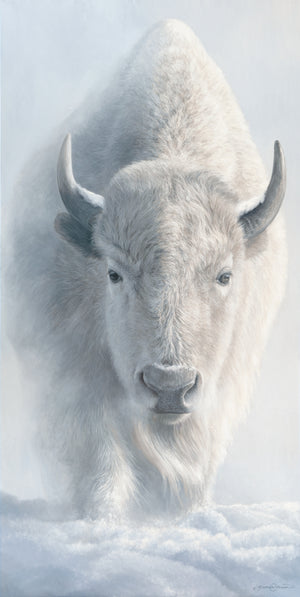
Bison have a distinctive visual presence that is difficult to confuse with another North American animal. Artists can capture their recognizable features through:
- Large shoulder hump
- Heavy head
- Curved horns
- Thick coat
- Massive frame
But the most interesting bison paintings don't necessarily depend on showing the animal at close range.
A solitary bison disappearing into a wide prairie can emphasize the scale of the landscape. A herd can create movement across an otherwise open scene. A close portrait can instead focus on the physical character of the animal.
The same subject can therefore produce very different artwork depending on what the artist chooses to emphasize.
How Does the Landscape Shape a Bison Painting?
With bison artwork, the landscape often carries as much visual weight as the animal.
The Great Plains provide a particularly strong setting because of their openness. A broad horizon can make a bison appear both powerful and surprisingly small within its surroundings.
Different environments can create very different impressions:
- Open prairie: Emphasizes distance, freedom, and the scale of the Western landscape.
- Mountain backdrop: Connects the bison with the broader wilderness of the American West.
- Winter landscape: Creates a stronger sense of season and survival.
- Tall grass and open range: Places greater emphasis on the animal's relationship with its habitat.
This relationship between animal and environment is one reason bison paintings can work as both wildlife art and Western landscape art.
What Stories Can a Bison Painting Tell?
A bison doesn't need to be shown in a dramatic scene to communicate something meaningful.
- Strength and endurance: The animal's size and physical presence naturally lend themselves to artwork centered on strength and resilience.
- Connection to place: A bison shown within its natural landscape can make the location an important part of the artwork rather than simply a background.
- Movement: A herd crossing open country can create a strong feeling of movement and scale without requiring an action-oriented composition.
- Quiet presence: A solitary bison can create a much quieter image—one focused on observation rather than drama.
These different interpretations give collectors room to choose artwork based on the aspect of the animal that resonates most with them.
Why are Bison Important to North American Wildlife Art?
Bison occupy an unusual position in wildlife art because their story is inseparable from the landscape they inhabit.
They aren't simply another species represented in North American wildlife paintings. They are closely tied to the history of the Great Plains and the cultural identity of the American West.
That makes bison artwork particularly relevant to people interested in:
- American Western history
- Great Plains landscapes
- North American wildlife
- Conservation
- Western-inspired art
- The relationship between wildlife and habitat
For artwork featuring a wider range of animals from the region, see the North American Wildlife collection.
How Can Bison Paintings Fit Into Western and Contemporary Interiors?
Bison artwork doesn't have to be limited to traditionally Western homes.
A painting with an expansive prairie, muted earth tones, or a restrained composition can work naturally in contemporary interiors. More traditional Western spaces may suit scenes that emphasize the landscape, open range, or historical character of the subject.
Rather than matching the artwork to a specific decorating style, consider what the painting contributes to the room:
- A wide landscape can introduce a sense of openness.
- A close bison portrait creates a stronger focal point.
- A subdued palette can sit comfortably alongside neutral interiors.
- A dramatic sky or landscape can provide contrast in a simpler room.
The artwork's relationship with the space matters more than whether the room is formally labeled "Western."
Final Thoughts
Bison paintings carry a particular sense of place. The animal's connection to the Great Plains, Western history, and North American wilderness gives the subject meaning that extends beyond its distinctive appearance.
Whether portrayed alone against an open horizon or as part of a larger landscape, the bison can represent a lasting connection to the American West and the wildlife that shaped it.